
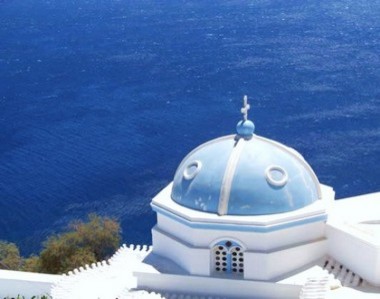
The pilgrimages of the fifteenth of August from Tinos to Amorgos. Their story, the architecture and the legends of the locals. Wherever one is on the fifteenth of August, Her grace. She will lead you to light a candle and celebrate with her in a whitish church………
The Aegean Panays other majestic and other humble and quiet are built in rocks, in caves, In rugged heights. On their walls precious treasures and in their images the hopes of thousands of believers. And they all have a miracle to tell you.
Tinos: Virgin Mary the Evangelistria Many Tamas and more thank you to Our Lady of Evangelistria, the Blessed, the Virgin of the Cyclades,the Virgin Mary of all the Aegean. Believers from all over Greece arrive at the port of Tinos and light a candle, they fulfill their wish and return.
A few minutes are enough for them before Her grace, the tears that flow effortlessly in front of Her image that appeared to the Nun Pelagia are enough for them, the uplifting of their soul and faith that they feel while leaving is enough for them. They know they will come back. 
Paros: Panagia Ekatontapyliani The Hundred Temple of the Ekatontapylian Paros is the largest sacred pilgrimage not only in the region of the Holy Metropolis, subject to, but also of the entire Greek area, after the Mount Athos complex.
And the sacred icon of the Virgin Mary of the Ekatontapyliani, which is a 17th century work, is the second pilgrimage of the Cyclades after the sacred icon of Our Lady of Tinos. 
Astypalea: Panagia Portaitissa
Inside the castle there are two pure white churches with elaborate stone bell towers, the oldest of Agios Georgios and the youngest of Panagia Portaitissa, one of the most beautiful of the Dodecanese.
There, on August 15, there is a dance festival in the courtyard but also on the roof of the church.. It has a great 18th century iconostasis, sculpture biceps eagle on the floor and uninhabited Byzantine images. 
Sifnos: Virgin Mary of Chrysopigi
According to folk tradition, The years of cursors in the cells of Our Lady of Chrysopigi, lived nuns. On a raid on the island, and while most of her nuns managed to get away from the raiders, one of them stayed behind in the monastery.
Pursued by Corsairs, the nun begged the Virgin Mary to save her. And she made it her miracle. It split the cove in two creating a fissure, throwing the raiders into the sea. 
Amorgos: Panagia the Hozoviotissa
Miracle happens here everyday: "while landslides keep happening and rocks fall on the monastery, never hit a man". All three monks in Hozoviotissa were rich, the white monastery which, perched on the rock, gazes from the terrace of the church at the sea.
The abbot, Father Spyridon, and two monks, Filaretos and Christodoulos, live in the arms of the rock, with the only complaint being the lack of respect of visitors who want to enter the monastery in indecent clothes. They serve Turkish delight and baked goods to the visitors and then Father Spyridonas takes them up to the monastery's catholicon to worship the icon of the Virgin Mary, to tell them the history of the monastery. 
Folegandros: Our Lady of the Dormition
Follow the cobblestone road that starts from the square of Punda and stop to lean over the cliffs that end in the wild rocks, where the sea breathes.
Panagia is perched on the rock above the beautiful Chora and is most likely built on the site of an ancient temple, building material which was used for its construction.
In the courtyard and inside the temple you will see ancient inscriptions, sculptures and statue bases. The icon of the Virgin that is kept in the church, associated with pirate stories and legends.

Mytilene: Panagia of Agiasos
One of the most important pilgrimages in Greece. In the icon, the Virgin Mary created by Luke the Evangelist with mastic and wax.
Her home was in Jerusalem, but it was transferred to Agiasos by the monk Agathon, the 803 A.D. Crowds of pilgrims flock on August 15th to venerate the Miraculous Icon. 
Santorini: Panagia Episkopi
One of the most remarkable monuments of the Cyclades. The temple was built in the 11th century with imperial sponsorship, by the Byzantine emperor Alexios A’ Komnenos. In its interior, excellent frescoes and a wood-carved iconostasis have been preserved.
One of her most important works, the beautiful icon of the Virgin Mary with Christ, in the type of Glykophilousa, flanked by figures of hierarchs, which is worshiped to this day and with special respect by the faithful. 
source: arttravel.gr