

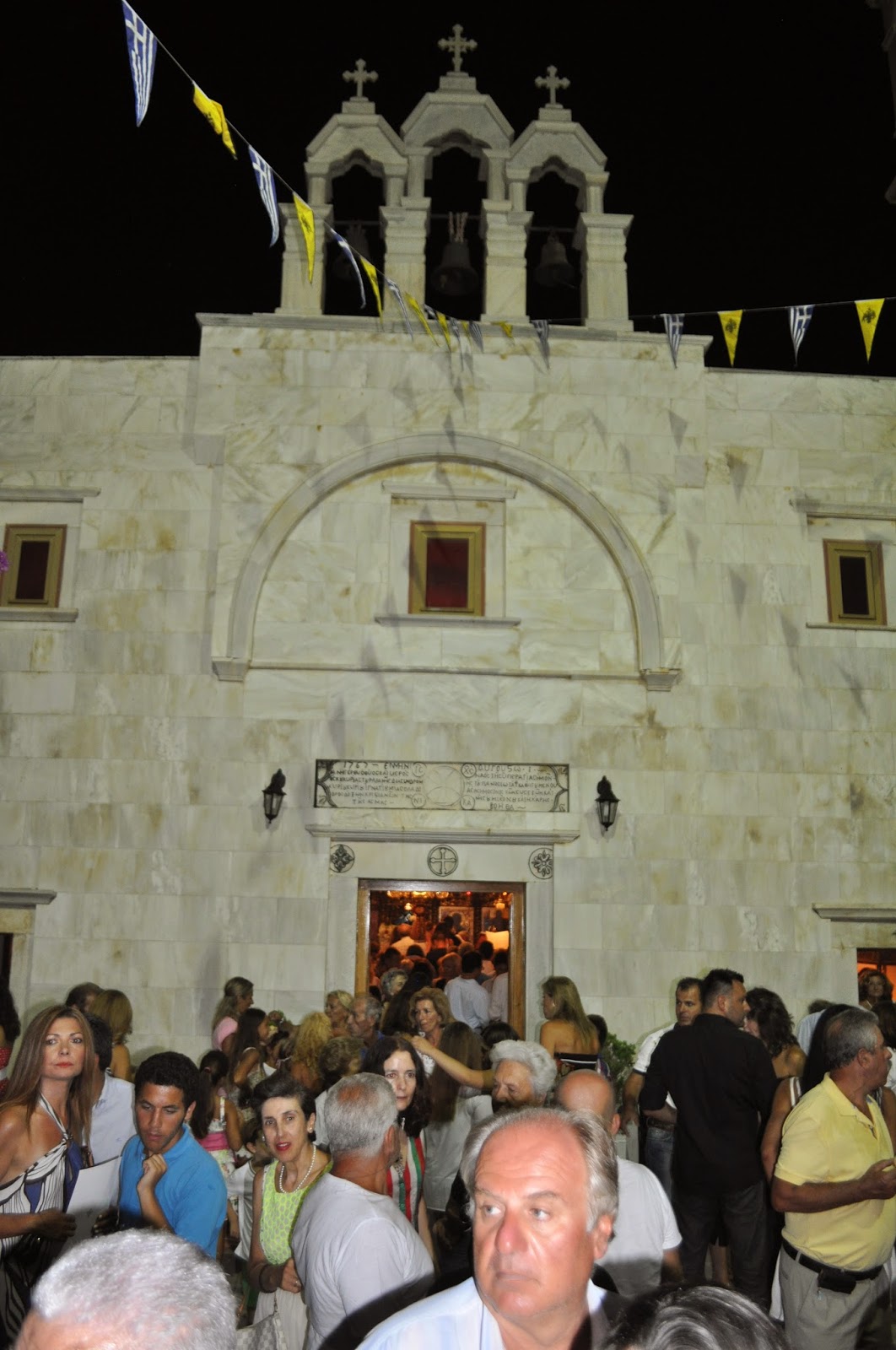
customs, events and festivities of the biggest religious festival of the summer
The Dormition of the Virgin Mary will be celebrated with great pomp and splendor throughout Greece this year., the biggest religious festival of the summer. Festive events, festivals and feasts in squares will give life to even the smallest village of our country……
It is not only Panagia of Tinos, Ekatontapyliani of Paros and Panagia Soumela in Vermio which gather thousands of pilgrims every year. Every temple and chapel dedicated to Megalochari will "wear" its festive, while the customs of each place will give special color to the events.
The classics of the fifteenth of August
The biggest and most famous festival takes place with all solemnity in Tinos. Already thousands of pilgrims arrive on the island to watch the procession of the epitaph the night before, as is done on Good Friday at the Epitaph of Christ. It is no coincidence that August 15th is considered the summer Easter.
The great religious celebration coincides with the anniversary of the torpedoing of the cruiser "HELLI" by the Italians. This year marks the 73rd anniversary, which will be celebrated – like every year – with relative invocation and throwing of wreaths. But the festival does not end on the island until the nine days of Panagia, that is, on 23 August.
Another impressive pilgrimage is taking place these days in the Cyclades, with Ekatontapiliani of Paros gathering thousands of believers in recent years, who will also this year watch with rapture the procession of the image of the Virgin Mary and her epitaph.
A special tone is set by the fireworks that turn the night into day not only in the port of Parikia, but also in the picturesque port of Naoussa. Dozens of boats approach the pier with lit torches and as soon as the "pirates" reach the harbor, a big celebration with island dances begins.
The largest pilgrimage in Northern Greece takes place at the historic church of Panagia Soumela near the village of Kastania in Imathia, where thousands of believers from all over the country and abroad attend the religious and festive events. The center of the celebrations is the miraculous icon of the Virgin Mary, crafted by the Evangelist Luke. Pontic groups take over the feast that follows until the morning.
With horses and boats at the fair
The customs that accompany the festive events from place to place are also rich. At the monastery of Panagia tou Mikrokastro in Siatista Kozani, the service is attended by faithful riders on decorated horses, a custom that has its roots in the Turkish occupation.
Subsequently, on horseback they return to the city thus giving the signal for the dance to begin, the food and of course the wine. And if in Kozani they saddle the horses, in Koufonisia they prefer boats. After the service and the meal at the church of Panagia in Kato Koufonissi, the faithful enter the boats and compete for who will reach Pano Koufonisi first.
In Nisyros one of the most special celebrations takes place at the festival of Panagia Spiliani. During Orthros, the bath of the Virgin Mary takes place accompanied by obituaries from the Enniameritisses, that is, women who have committed to spend nine days and nights of prayer in the cells of the monastery, offering various tasks for the cleaning and preparation of the monastery. The "holy" bath is distributed to the pilgrims after the meal served in the temple.
The three-day festival of Xylopanagia, of the oldest church of Serifos, in the village of Panagia, begins with an original custom. According to tradition, any couple that "opens" the dance around the old olive tree in the courtyard of the temple gets married within time. And since it's a matter of speed, the "fights", i.e. the fights, which used to be set up among men for the most beautiful woman, they gave their name to the festival. The 15th of August is celebrated in Alonissos with the revival of a traditional wedding. Locals and visitors take it upon themselves to play their roles, while after the wedding there is a big feast with roasted goat and local wine.
The "snakes of Panagia" become the focus of the celebrations at the Holy Monastery of Panagia of Fidousa in Kefalonia. According to tradition, small wretched snakes with a cross mark on their heads appear in the bell tower every August 15th and the church committee takes them to the churchyard for worshipers to see.
It is believed that snakes bring good luck to the island, while their non-appearance is a bad omen. Another unique phenomenon takes place on this day on the island, specifically in Panagia Gravaliotissa, the lilies that are placed on the icon of the Virgin bloom for the second time in a year.
Summer Easter
On the island of Apocalypse, on Patmos, exuberance characterizes every religious celebration. So, the monks of the island observe the custom of the epitaph of the Virgin Mary, a custom with Byzantine origins. The ornate epitaph roams the alleys of the island, while the bells of all the churches of the island ring non-stop. Similarly, the Dormition of the Virgin is celebrated in cosmopolitan Skiathos, with the epitaph wandering to the tune of eulogies.
One of the most overwhelming festivals is that of the Dormition of the Virgin in Olympus of Karpathos, where these days are deeply connected with the mourning that characterizes this juncture for Christianity. The highlight of the traditional celebration is the dance that takes place in the small square in front of the church with the organists playing the slow "Kato Horo".
At first, the men seated at the table and with a piece of basil in their lapels sing to the accompaniment of lute and lyre. As darkness falls the dancing begins, into which the women dressed in their traditional holiday costumes slowly enter.
In Agiaso, Lesvos, the center of the celebrations is the famous church of Panagia of Agiaso, where the faithful, visitors and locals, enjoy one of the most beautiful festivals of the Eastern Aegean. The icon of the same name is the work of the Evangelist Luke, decorated with candle and mastic. Many of the pilgrims walk 25 kilometers from the city of Mytilene to reach the churchyard, where they spend the night.
On the day of the celebration, the image is taken around the temple, while the festive events reach their climax with the music and dance events in the village square.
Feasts and traditional treats
In the highest village of Greece, the much-sung Samarina, every fifteenth of August thousands of visitors arrive at Megali Panagia to set up one of the biggest festivals in the Grevena region that lasts for three days. The same happens in every village in the country, from the thousands who have the name of Magalochari, with rich traditional food, plenty of wine and of course traditional music and dancing.
At Panagia Panochoriani in Amorgos, the local specialties are the ones that stand out, with the potato and vinegar stealing the show. Of course, the famous "baked" raki of the island could not be missing either.
also, the festival of Panagia Thalassini in Andros stands out for its fruit and local sumada. Pilgrims and visitors are also welcomed in Petra of Lesbos with a home-made specialty, where they offer "kikesi", i.e. bull boiled with wheat, while at Panagia Portaitissa of Astypalaia, stuffed lamb is served which the locals call "Lambriano".
Of course, the traditional Ikarian dance is the star of the August 15th celebrations on the island, where there is no shortage of local mezes, such as roasts and goat meat. Potatoes, rice, veal and stew includes the meal set at the large table of the Holy Dormition Temple, at Panagia of Thassos.
After the procession of the image, the faithful gather in the courtyard of the church, where the feast flares up with dances from all over Greece, appetizers and wine. In Pyrgi of Chios with its fifty churches, the festival of Megalochari begins with the religious events, but ends with a feast in the square, where "Pyrgousikos" is danced, a dance happy and fast.
The "dolias"
In Paleopyrgos Pogoniou, the "dolias", an old custom, star in the celebrations. According to tradition, the command (outfit – dolia) it is given by the "doli pasha" who is appointed by one of the elders, who takes the glass of wine and clinks with a bystander. He drinks three glasses or three times and dedicates them each time to different ones by asking the instrumentalists to play a song.
Then, the rest, in the order set by the "doli pasha", dedicate their wishes wherever everyone wants, asking for a song as well. One of the purposes of the custom was to dispel minor misunderstandings that had been created and to restore unity among the villagers.. In the evening follows a traditional festival with local costumes and traditional dances. The party lasts until the morning hours.
Source : tovima.gr
Diligence : NewsRoom Mykonos Ticker